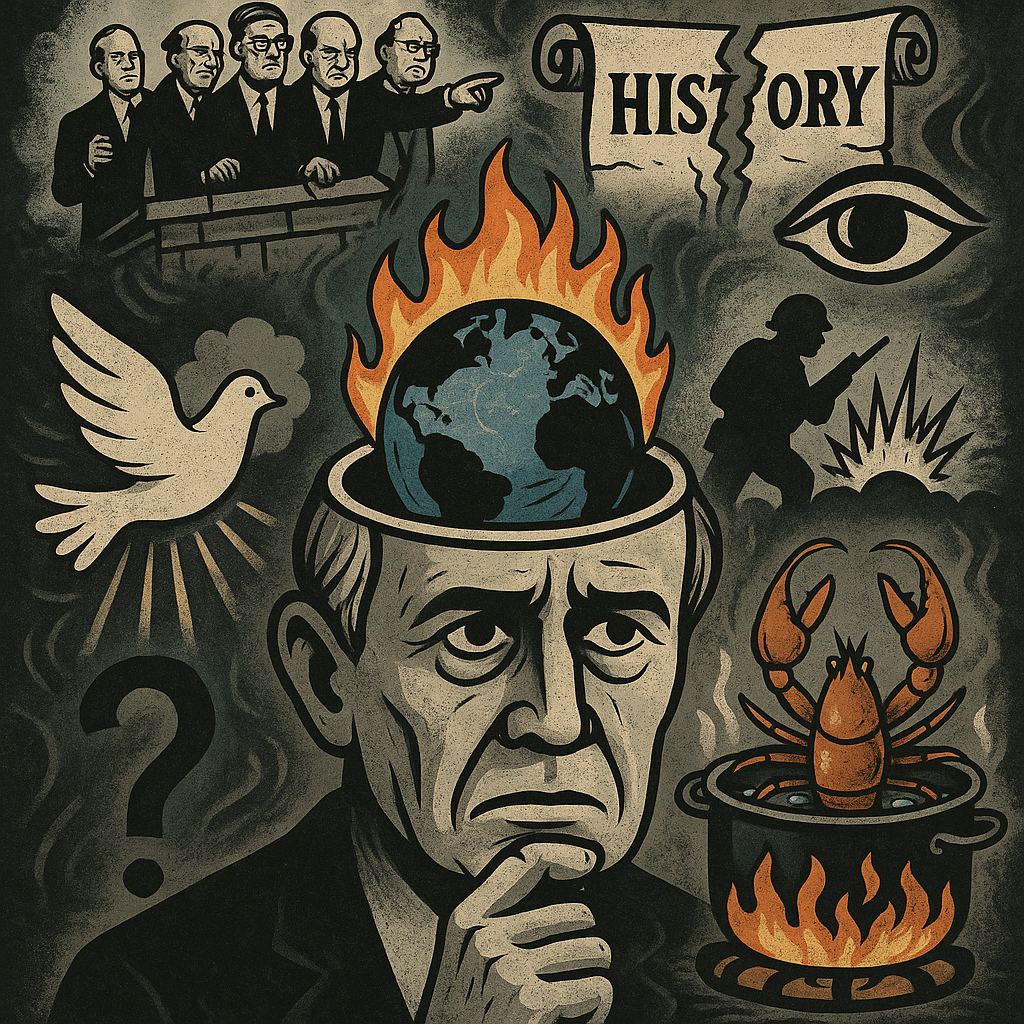
The Craziness of the Human Race
This morning I was half-awake, still curled in the warmth of my bed, when I hit play on a podcast exploring the tangled events of the Middle East. It began in 1953—just a year after I was born—when the CIA helped orchestrate a coup in Iran to install the Shah, replacing the democratically elected Mohammad Mossadegh. That single move eventually led to the 1979 revolution, when the Iranian people rose up and overthrew the Shah, setting the stage for decades of tension that still echo today.
As the podcast drifted through my ears, I caught names like Paul Wolfowitz, neocon ideology, the Bush presidencies, Clinton, Obama. I’ll admit, I probably absorbed only 10% of it—I was drifting in and out of sleep—but what struck me was the attempt to present a cohesive, credible narrative of history, one that isn’t often told in mainstream channels. It made me reflect on how often we consume news that has no historical context—just headlines and sound bites detached from their origins.
And therein lies a deeper problem: we keep addressing the symptoms without ever tracing things back to the root causes. The world watches a conflict explode and react with shock—but how many people know what led up to it? When did the detour occur? What subtle manipulation of truth or revision of history masked the original betrayal?
There’s a quote I once read about study: if you’re confused by something, go back to just before the confusion started and find what you didn’t understand. Was it a word? A concept? A faulty assumption? That wisdom can be applied to history too. If the world seems insane, maybe it’s because we stopped understanding where we went wrong.
We—humans—tend to let small groups of elites call the shots while we just try to get on with life. It’s always been this way. And unless something directly affects our family, our finances, or our daily routines, we tend to tune out. But that indifference is exactly what gives power its fuel.
It’s a rigged game, and the result is often the same: despair, conflict, division, betrayal. I sometimes think there’s some unseen force that feeds on our emotional entanglement—our fear, our confusion, our rage.
Still, despite all that, I find solace in the idea that some people still dig. Some souls still search for the truth, unearth the connections, and try to shed light on what’s actually going on. And for those of us willing to look, those facts are out there. They’re not hidden. They’re just buried under noise.
For me, the desire to understand history is similar to my desire to understand my own health. I want to get to the root of the issue, not just mask the symptoms. Whether it’s a blood sugar spike or a geopolitical crisis, understanding the cause gives me some degree of control. And that, in itself, is a form of freedom.
But I’m not going to spend the rest of my life wading through conspiracy theories and war documents. I have more important things to do. I want to communicate, create, laugh, help who I can, and keep my body strong. My impact may be small—micro, even—but it will be mine.
Maybe that’s all we can do. Wake up. Stay curious. Choose optimism over apathy. Maybe our greatest weapon isn’t protest or outrage, but an unwavering belief that there is something greater, just beyond the veil of our current understanding.
Maybe we are lobsters in a pot of boiling water. But I like to believe there’s a way out—before the water turns to fire.