India Trip : February/March 2019
We arrived in Mumbai in the morning at around 10.30 a.m. We boarded the plane in Melbourne at 1a.m on Friday, February 15th 2019 . Finn had driven us out to the airport. Georgie and I were off for a month in India and he was going to be on his own for the next 30 days. We said our goodbyes, he drove off and that was that.
We flew in Premium economy on Singapore Airlines, using our frequent flyer points in an Airbus 380. What wonderful seats we had. I took my first ever sleeping tablet, a mild one, and after a short wait I dropped off to sleep. A short early morning stop in Singapore and we were on our way again.
This was to be my first day in India and to be quite honest, I had no idea what to expect apart from scenes from Indian movies that I has seen over the years. We caught a taxi from the airport. Our bags went on top on a roof-rack with one flimsy piece of rope holding them on, much to Georgie’s dismay.
Before we left the airport, we had a quick meal. Airport food is normally crap but this was the best food that I had ever found in an airport, anywhere.
The drive to the Ferreira house in Girgaum took around one eventless hour, nothing much to see. Ferreira House has been in the Ferreira family for over 200 years. It is situated in the “village” of Khotachi Wadi in the old part of Mumbai. We only had two days there and even though being in the house was absolutely fabulous our room was small and our bed smaller (and hard, apparently Indians like hard beds), in fact the bed was so small that when I rolled over in the middle of the first night if fell out and crashed onto the floor disfiguring my glasses in the process.
I took a punt on Ferreira House, Georgie didn’t want to stay there but it was one of the most memorable experiences that we had in India.
James and his older brother Owen, who was visiting from Adelaide, were perfect hosts. We had some great conversations, covering many topics.
Aurangabad
The Aurangabad leg of our trip was all about visiting the Ellora and Ajunta caves. We stayed in a rather bland hotel as we only had 2 days to explore both cave complexes. The hotel and the drives out of and back into the town was about all we saw of Aurangabad. We had a driver named Patel. A lovely Moslem man who loved to share his knowledge of the area with us as well as talking about his family, being a Moslem and details of the geography of the areas as we drove through them.
There was an American tour group staying at the hotel who visited the caves on the same days we did. The group was made up of east coast liberals who had probably been vaguely involved in the counter culture or politics at some point of their lives. The first night we had a long chat to one of the ladies about American politics. The challenge then was to engage the others in communication which wasn’t so easy but eventually we did over the next two days until we said goodbye at Aurangabad Airport very early on Tuesday morning as we made our way back to Mumbai and onwards to Udaiphur.
Our plan was to spend two days exploring Udaiphur on our own until John and Flora arrived on Thursday night.
The two days visiting the caves was bloody hard work. Aurangabad is desert and we experienced our hottest days in India. My face looked like I had downed a couple of bottles of vodka after the first day exploring Ellora. By the time we came out to meet Patel late in the afternoon the temperature was just shy of 40 degrees Celsius.
But it was worth every painful step, every bead of sweat, every aching muscle. They were stunning, awe inspiring, amazing … like nothing I had seen in my life and they were beautiful.
Early on Tuesday morning we met Patel and drove to Ajunta. Today’s drive was three hours of bumpy, unmade roads. Shake, rattle and roll. All I could think of was “What goes to Ajunta must return from Ajunta.” And return we did back along the bumpy, dry road. Overall for me Ellora was more breathtaking. But this doesn’t mean that Ajunta wasn’t spectacular, it was.
As we got closer to the caves Patel took us to a lonely roadside café that looked like it was going to be a toilet and drink stop. While we were there Patel introduced us to a guy named ………. He told us that there were two alternatives to enter the caves. One was to catch the tourist bus and go in with the multitudes and the other was to enter from the high vantage point that Captain John Smith first saw the caves from in 1819. …… told us that his younger brother Farak would take us on this adventure and guide us from cave to cave. “Don’t worry, it won’t cost you any money, just come to my shop on your way back to your car after you have explored the caves.” This sounded reasonable at the time. We had only been in India for 4 days and had no idea about the” tourist traps” that were to be set over the coming weeks. You see, nothing in India comes cheaply if you are a tourist, the people are delightful, friendly and helpful and when you ask them how much you should pay they always say “Up to you”. Even though this sounds innocent enough the implications are immense and it is very easy to lose face if you don’t have a feel for this.
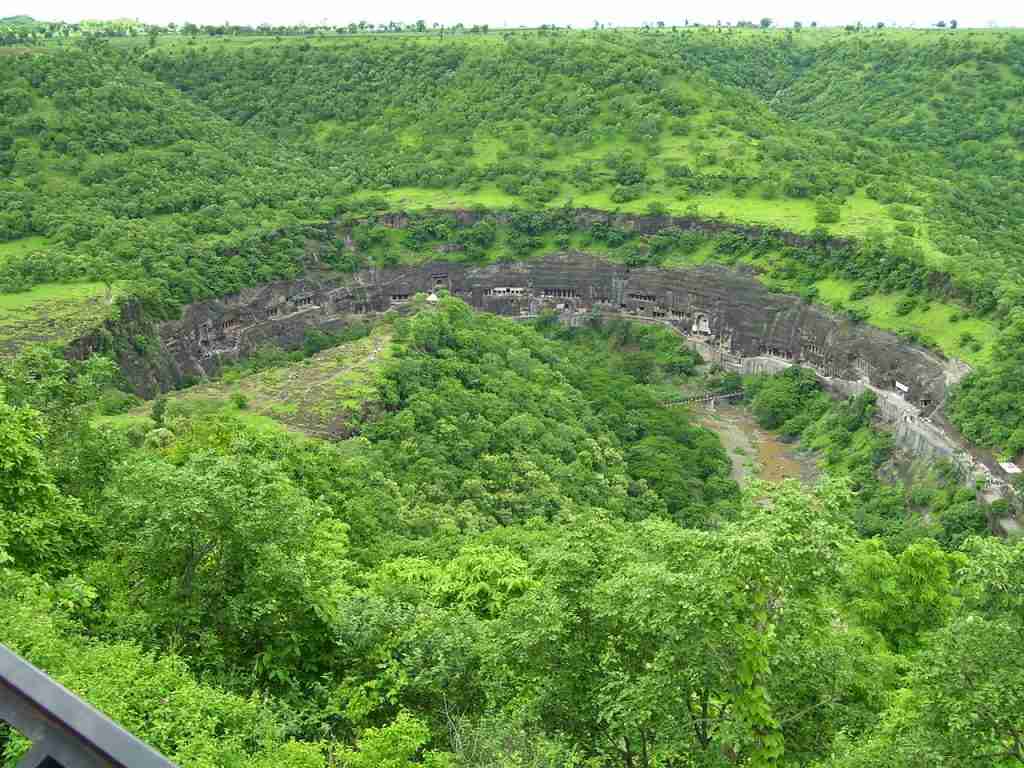
Farak was fantastic. Polite, handsome, he spoke three or four languages that he had learned over the past 18 years while guiding people through Ajunta. Entering the cave complex from the vantage point that we had chosen was a grand experience. The journey was like coming down Ferntree Gully’s 1000 Steps but far more of an immense experience. The waterfalls and the Waghur River were parched and dry. Farak told us that when monsoon arrives the river is torrential and the waterfalls powerful with water cascading into the valley. I must say this was hard to believe until he pulled out his phone and showed us a video. He was such a gentleman, walking down the steps, holding Georgie’s hand like she was a princess, descending step by step until we rested to eat a small lunch and take photos from our vantage point half way down. We felt special as we watched the masses who had entered through the mundane tourist entry. We could see the 34 caves that were open for the public and once again as at Ellora we stared in awe.
When we finally arrived Farak suggested doing the journey backwards as we would have better light and less tourists. The walk to cave 34 was an arduous trek, climbing up and down huge steps in the hot sun until we finally arrived. All I will say is that it was worth every footstep, every ache, every moment that we just wanted to stop and drive back to the hotel. The only problem was that when we finally got to the big caves at the beginning (remember, we went back to front) we were just simply exhausted, over heated and my feet felt like the devil had cursed them.
We followed Farak to the bus that would take us to the car park. When we alighted he gestured to follow him, which we did until he guided us to his older brother’s shop which was full of trinkets and carved stone elephants and incense holders which we would later see at many other tourist spots and shops. I realized that we were in a situation, we were in their debt, Farak had kindly guided us for the past 5 hours or more in the hot sun and now was the time for them to make a substantial sale except there was nothing worth buying. I almost gave in and spent $300 on a crappy carved elephant just to get our exchange in. But, Georgie came to the rescue and staunchly stated that we were not going to buy anything and that we would give Farak 500 rupees for his trouble. I must say that the brothers didn’t make too much of a fuss about this and we made our way back to the car and Patel …… feeling a bit guilty but devoid of the regret we would have felt if we had purchased that damn ugly elephant carving.
.
From Wikipedia
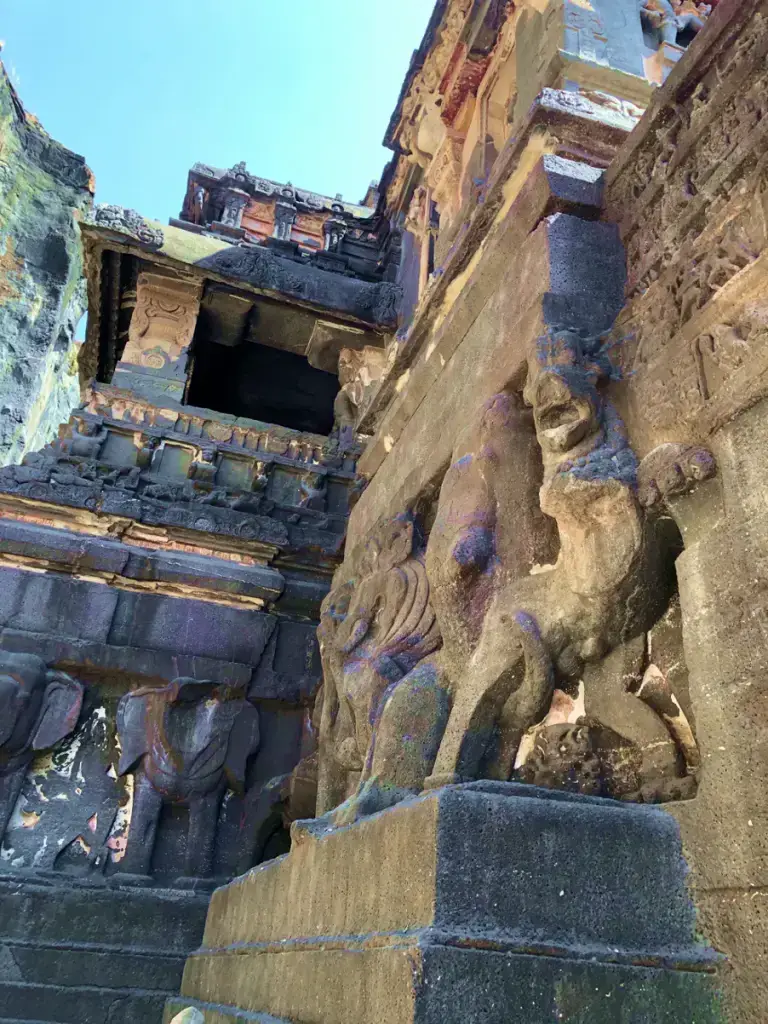
Ellora (\e-ˈlȯr-ə\, IAST: Vērūḷ), located in the Aurangabad district of Maharashtra, India, is one of the largest rock-cut monastery-temple cave complexes in the world, and a UNESCO World Heritage Site, featuring Buddhist, Hindu and Jain monuments, and artwork, dating from the 600-1000 CE period. Cave 16, in particular, features the largest single monolithic rock excavation in the world, the Kailasha temple, a chariot shaped monument dedicated to Shiva. The Kailasha temple excavation also features sculptures depicting the gods, goddesses and mythologies found in Vaishnavism, Shaktism as well as relief panels summarizing the two major Hindu Epics.
There are over 100 caves at the site, all excavated from the basalt cliffs in the Charanandri Hills, 34 of which are open to public.[3]These consist of 12 Buddhist (caves 1–12), 17 Hindu (caves 13–29) and 5 Jain (caves 30–34) caves,[6][7] with each group representing deities and mythologies that were prevalent in the 1st millennium CE, as well as monasteries of each respective religion.[6] They were built in proximity to one another and illustrate the religious harmony that existed in ancient India.[2][8] All of the Ellora monuments were built during Hindu dynasties such as the Rashtrakuta dynasty, which constructed part of the Hindu & Buddhist caves, and the Yadava dynasty, which constructed a number of the Jain caves. Funding for the construction of the monuments was provided by royals, traders and the wealthy of the region.[3][9]
Although the caves served as monasteries, temples and a rest stop for pilgrims,[7] its location on an ancient South Asian trade route also made it an important commercial centre in the Deccan region.[10] It is 29 kilometres (18 miles) north-west of Aurangabad, and about 300 kilometres (190 miles) east-northeast of Mumbai. Today, the Ellora Caves, along with the nearby Ajanta Caves, are a major tourist attraction in the Marathwada region of Maharashtra and a protected monument under the Archaeological Survey of India.[11]
Ajunta Caves
From Wikipedia
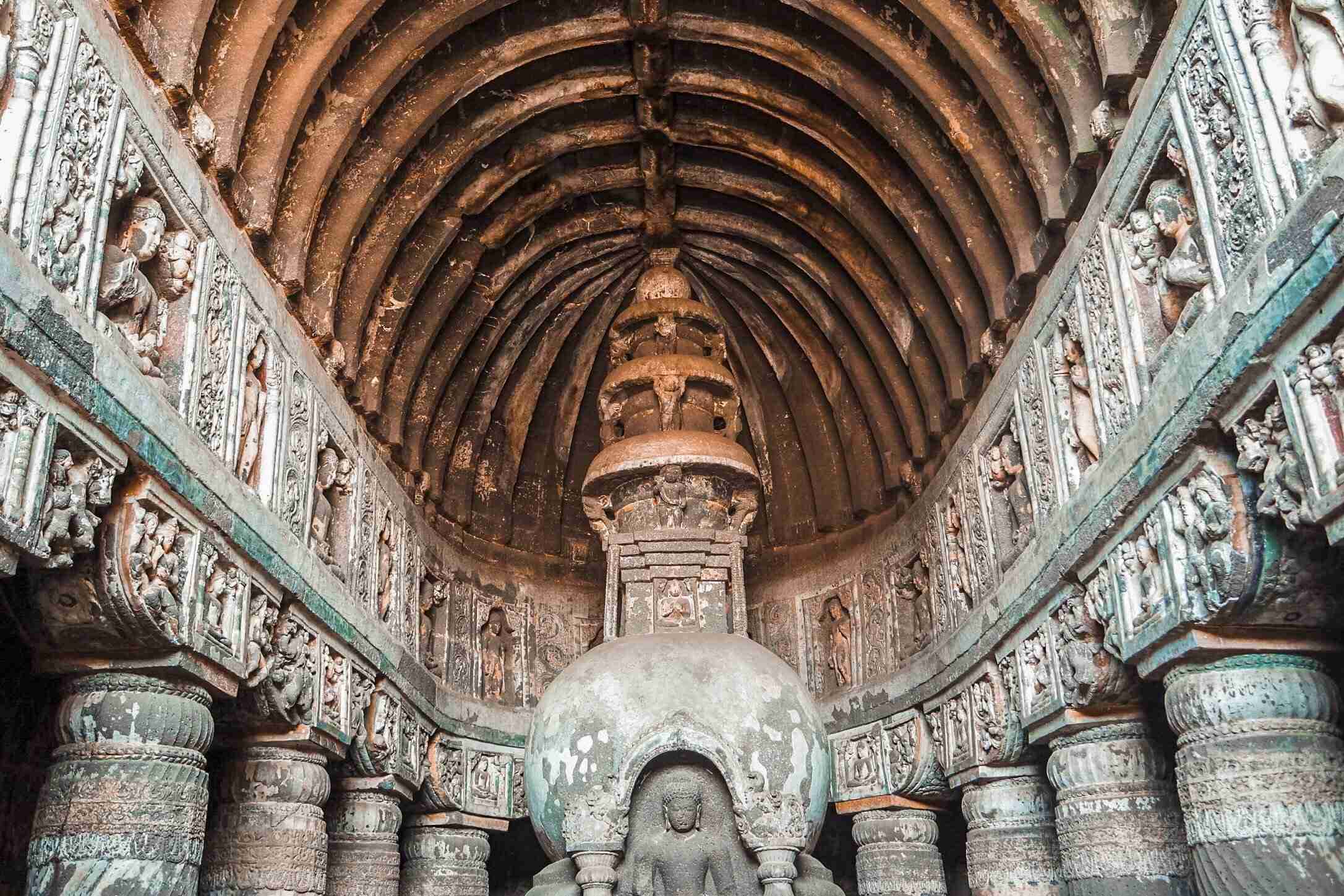
The Ajanta Caves are 30 (approximately) rock-cut Buddhist cave monuments which date from the 2nd century BCE to about 480 CE in Aurangabad district of Maharashtra state of India.[1][note 1] The caves include paintings and rock-cut sculptures described as among the finest surviving examples of ancient Indian art, particularly expressive paintings that present emotion through gesture, pose and form.
According to UNESCO, these are masterpieces of Buddhist religious art that influenced the Indian art that followed.[5] The caves were built in two phases, the first phase starting around the 2nd century BCE, while the second phase was built around 400–650 CE, according to older accounts, or in a brief period of 460–480 CE according to later scholarship.[6] The site is a protected monument in the care of the Archaeological Survey of India,[7] and since 1983, the Ajanta Caves have been a UNESCO World Heritage Site.
The Ajanta Caves constitute ancient monasteries and worship-halls of different Buddhist traditions carved into a 250-feet wall of rock.[8][9]The caves also present paintings depicting the past lives and rebirths of the Buddha, pictorial tales from Aryasura’s Jatakamala, and rock-cut sculptures of Buddhist deities.[ 8] Textual records suggest that these caves served as a monsoon retreat for monks, as well as a resting-site for merchants and pilgrims in ancient India.[8] While vivid colours and mural wall-painting were abundant in Indian history as evidenced by historical records, Caves 16, 17, 1 and 2 of Ajanta form the largest corpus of surviving ancient Indian wall-painting.[12]
The Ajanta Caves are mentioned in the memoirs of several medieval-era Chinese Buddhist travellers to India and by a Mughal-era official of Akbar era in the early 17th century.[13] They were covered by jungle until accidentally “discovered” and brought to Western attention in 1819 by a colonial British officer Captain John Smith on a tiger-hunting party.[14] The Ajanta Caves are located on the side of a rocky cliff that is on the north side of a U-shaped gorge on the small river Waghur,[15] in the Deccan plateau.[16][17] Further round the gorge are a number of waterfalls, which, when the river is high, are audible from outside the caves.[18]
Udaiphur
After flying back to Mumbai from Aurangabad our next flight was to Udaiphur. We arrived at the airport a bit later than expected due to a delayed departure. The airport was clean, sort of modern but non-descript. We were met by a driver who packed our bags in and drove through a relatively ugly landscape. I must say that I was a bit worried as Georgie had told me that Udaiphur would probably be the highlight of our journey through Rajasthan. The trip took about an hour. In some ways it was like the night we arrived in Prague. As we drove through the streets I was dismayed by the post communist architecture and thought that we had made a huge mistake only to be blown away the next morning when I woke up to go for an early morning walk.
Our taxi couldn’t take us in to the tiny streets of the old city of Adaiphur so he stopped just outside the wall and the bridge over the lake where we were met by an electric tuk tuk sent by our hotel.
We decided to walk and as soon as we crossed the first bridge everything felt and looked right. There seemed to be a completeness. It really felt like we were in India. I had pulled out my new tiny Osmo Pocket video camera and was snapping video like a demented child at a birthday party.
When we finally arrived at our hotel we weren’t disappointed. The reception area overlooked Lake Pichola and the view of the other side was spectacular, then we were taken to our room which was straight out of a Rajasthani wet dream. Tiled and mirrored walls and roof, amazing views of Udaiphur, the City Palace and the lake.
We were both so excited. By now we had only been in India for 5 days but each day had been so full of adventure that it seemed like 5 weeks. Flora and John weren’t arriving until Friday which was still 2 days away. I was so damned happy about being in India. After our bags were unpacked we explored a bit and had dinner on the rooftop of our hotel. It all seemed so exotic. The moon was full, the food was fabulous and life was good.
In the early morning the streets of Agra awaken to the smell of fresh, sweet and gooey breakfast delicacies being deep fried and dipped in a sweet hot liquid. Smells of urine waft up as monkeys play and grapple with each other to fight over who gets the best banana doled out to them by an old man with a big hessian bag full.
Women sit on the street in groups with their baggage next to them waiting for a bus to “who knows where” while young men stand on top of the big bus loading luggage as nameless people walk up the steps to find their seats.
As a westerner you can be invisible but all it takes is a smile or a slight nod of the head and all of a sudden you exist and are part of their group. “Good morning” is a universal solvent no matter where you are but it seems to have more power in Agra and India in general. Faces animate and come alive with that simple greeting. “Oh, you acknowledge that I exist so I will acknowledge that you also exist.”
I stopped at a breakfast shop and bought a small bowl of curry with 2 delicious deep-fried puffs. I gave the man 10 rupees and told him to keep the change, but he insisted on returning my 2 rupees change. A far cry from the touts who swarm around you at tourist spots …. “I’m not a guide, I’m a student. You don’t need to give me any money, I just want to learn English.” A well-rehearsed line that we got from the kids at Fatephur Sikri 2 days earlier.
We all need to survive.
Serendipity in Agra.
Over the years I’ve come to recognize that magical events really do happen. On our first morning in Agra we went in search of a shopping opportunity. Flora was keen to find some places where she could purchase a few pieces of clothing, some scarves … you know what I mean. Flora just likes to shop. She had also read about an Indian restaurant called “Zorba the Buddhist” where she wanted us to eat lunch. The girls wanted to go shopping so we got our driver Vijay to take us to a bazaar, but it was far too dirty, busy, grotty and teeming with people almost like the contents of a nutri-bullet being whizzed into a massive chaotic paste of humanity. Somehow, we ended up in a relatively sedate shopping area called Sadar Bazar. I found a book shop and Georgie wandered in, we found a few books, some pens and a few other bits and pieces. In the mean time John had been approached on the street by a man who invited him to view some scarves down some stairs in a really out of the way group of shops. To keep things short and sweet we found scarves, some silver bangles and some semi-precious stones. We also had lots of fun in the process and asked to pay with card instead of cash. The people in the shop didn’t have an Eftpos machine that worked so Flora, John and Georgie went of to another shop to pay. I went looking for them and eventually found them in another jewelry shop which ironically was right next door to Zorbas. In actual fact Zorbas was owned by Gagu, the same guy who owned the jewelry stores and yes, we did have lunch there.
Lorem ipsum dolor sit amet, consectetur adipiscing elit. Ut elit tellus, luctus nec ullamcorper mattis, pulvinar dapibus leo.
Don’t Laugh ……. I got lost in Delhi
Since we’ve been in Delhi I’ve been waking up before the others, putting on some shorts and going for a walk. Well only 2 walks so far but it’s been nice wandering around before the city wakes up for real. Yesterday morning I stuck to the grid and even though I didn’t come back with any food I sort of oriented myself. This morning I got a bit more “Robinson Crusoe” and decided to walk out the gates. At first, I was convinced that I was totally in control. I walked out onto the main road where things were a fair bit busier and turned right. I felt like I knew where I was but at the same time, I also felt a bit daring and started to stop outside street food vendors who were preparing flat breads and morning curries. I’d also gone into a grocery store and bought a couple of things including some packaged breakfast cereal for John and Flora who were adamant that they weren’t going to eat anything at all from the streets. We were all knocking back a pill called Travelan before every meal that was designed to minimize the risk of getting dysentery or Delhi Belly as it is unfortunately called. This made it easy for me to eat whatever I wanted although I did get a bit “runny” in the first days of our arrival after eating with locals in Mumbai.
Back to the walk. The road I was walking on was a circle road which surrounded the grids. Eventually I turned in, but nothing looked familiar. The more I walked the more I felt like an alien, a stranger in a strange land. I didn’t panic but I must admit that I visualized the others freaking out as the day moved on and I wasn’t back.