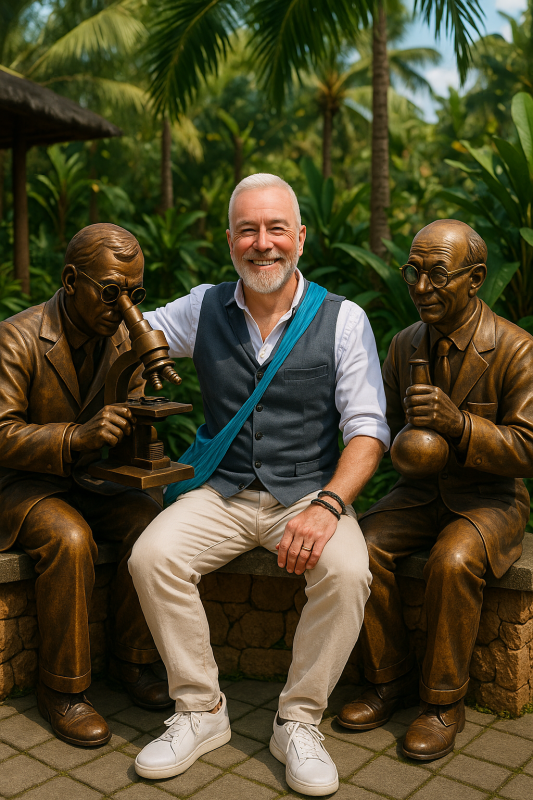
Becoming the Scientist of Your Own Life
At its core, science is not a belief system. It’s not a list of immutable facts or a rigid dogma handed down from on high. It’s a method — a framework for asking questions about the world and rigorously testing the answers to see if they hold up under pressure.
A scientist begins with curiosity and proceeds with doubt. “I think this might be true,” they say, “but let’s test it. Let’s observe. Let’s challenge it.” If the idea survives repeated testing, it becomes a theory — not a wild guess, but the best explanation we have, grounded in real evidence.
And here’s the thing: you don’t need a lab coat to be a scientist.
A scientist is anyone who commits to this process:
Observing
Questioning
Testing
Measuring
Adjusting
By that definition, you can be a scientist — especially when it comes to your health and well-being.
If you measure your blood glucose every morning, tweak your diet, and track the changes — you’re doing science.
If you experiment with your sleep by testing melatonin, magnesium, or a new bedtime — that’s science, too.
If you record your mood, energy, or digestion after reintroducing certain foods — again, science.
How Ordinary People Can Use Scientific Thinking in Daily Life
You don’t need a degree to think like a scientist. You just need a willingness to:
Track what’s happening.
Sleep, energy, weight, mood, blood sugar, digestion, training performance — whatever matters to you.
Change one thing at a time.
Introduce a supplement. Remove a food. Add walking. Drop alcohol.
Observe and record the effects.
Look for trends, not anomalies. Your body speaks in patterns.
Adjust and repeat.
Remain open. Let your lived experience guide your next move.
Science is slow. It resists jumping to conclusions. And that’s its superpower. It’s the antidote to hype, fads, gurus and glossy promises. Your body is your lab. And you — not your doctor, not your coach, not some influencer — are its head researcher.
That’s exactly what I’ve done over the past few years: through cancer, blood sugar swings, liver repair, testosterone therapy, and more. I didn’t just “try things” — I tracked them. I compared data with how I felt. When something worked, I doubled down. When it didn’t, I moved on.
Science gave me back control.
Applying Scientific Thinking to Life — Right Now
This morning I woke up feeling clear and energized — which I’ve noticed tends to happen when I get at least 50–60 minutes of deep sleep, according to my Oura Ring. Last night I clocked 57. That’s real-time data backed up by real-time experience. I feel good. Enthusiastic.
But it hasn’t been like that every morning.
It’s now three weeks since my triple hernia operation. I’d hoped for a quicker bounce back, but reality has been humbling. My body tone and energy levels are nowhere near where they were before surgery. Over the past 21 days I’ve barely walked, haven’t lifted weights, and only resumed sauna/cold plunge therapy a couple of days ago. No surprise — my energy is down.
On top of that, I experimented with carbs again after nearly six months of strict keto. I got careless, indulged, and paid the price. I wasn’t checking ingredients, I wasn’t tracking macros. I was seduced by the idea that food is indulgence rather than fuel.
So I slapped on a CGM (continuous glucose monitor). Lo and behold — my blood sugar graph looked like the Himalayas. Nothing disastrous (I didn’t spike over 8), but the average sat around 5.3 — too high for my liking.
Two days ago, I dropped the carbs again. My levels instantly stabilized.
That’s observation. That’s data. That’s science in action.
I also haven’t had any HBOT since leaving Bali in May. No glutathione infusions. No testosterone shots. All these things were helping me thrive — and I’ve been feeling their absence. Again: more data.
Even my old fibula fracture — calm for months — has started to ache again post-surgery. Coincidence? Maybe. Or maybe I’m noticing more now that other things have been put on hold. Science doesn’t mind the “maybe.” It just keeps watching, recording, questioning.
Staying Curious, Staying Open
The reason I’m listing all of this is because these are my observations. This is how I do science. This is how I make sense of what’s working and what’s not. And if I’m smart, I’ll use these insights to shape my next steps.
Because life isn’t just about blood sugar or muscle mass or sleep quality. It’s also about creativity. Relationships. Learning. Compassion. Social awareness. Adventure. Joy.
And all of those areas benefit from the same mindset:
Pay attention.
Stay curious.
Question your defaults.
Be willing to change your mind.
Even when I get stuck — physically, mentally, emotionally — I stay open. I want to find better ways. If someone else has used scientific logic to improve some facet of life, I’m all ears.
It brings me closer to truth — not some abstract capital-T “Truth,” but something more personal: a deeper understanding of what works for me.
And that’s worth everything.
So if you’re reading this…
Start asking questions. Start taking notes. Become the scientist of your own life.
Because no one else is better qualified to figure you out than you.