Novavax in Australia
I am trying to get my head around Novavax, it’s efficacy, the side effects and future health implications. Based on the current political and health response to Covid the “powers that be” have proclaimed that the whole world must be vaccinated. That’s a whole subject on it’s own, one which I won’t go into here. Whether I need it or not to protect me against Covid is another story. The reason I need to get vaccinated is to get on a plane so I can travel.
Most of the following is cut and pasted from various articles which I found online. The data looks OK but I cannot verify it as correct, true but it looks pretty good to me when compared to the other versions of the Covid 19 vaccines available., some of which have rather nebulous potential side effects.
Novavax is a protein vaccination (nano-particle based).
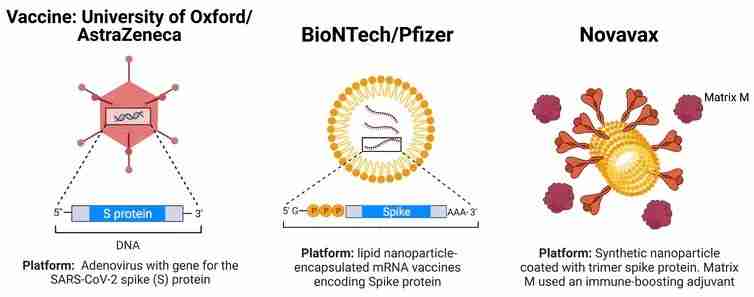
Unlike the mRNA and vector vaccines (Pfizer, Asatra Zeneca and Moderna), this is a protein adjuvant (an adjuvant is an ingredient used to strengthen the immune response). While other vaccines trick the body’s cells into creating parts of the virus that can trigger the immune system, the Novavax vaccine takes a different approach. It contains the spike protein of the coronavirus itself, but formulated as a nanoparticle, which cannot cause disease. When the vaccine is injected, this stimulates the immune system to produce antibodies and T-cell immune responses.
Protein-based vaccines, which have already been successfully used for the immunization against various infectious diseases ranging from acellular pertussis and tetanus to diphtheria and pneumococcus, often require adjuvants to enhance their immunogenicity.
The Novavax COVID-19 vaccine contains a protein (made using moth cells) plus an adjuvant (made from tree bark). An adjuvant is an ingredient added to boost a person’s immune response, creating higher levels of antibodies.
The Novavax vaccine uses a telltale piece of the coronavirus: the notorious spike protein. All alone, the spike protein is harmless and can’t cause COVID-19. When your immune system encounters the lonely spike protein, it produces antibodies against it. This gives you protection against future COVID-19 infection.
“Unlike mRNA vaccines, the spike protein is already premade in the Novavax vaccine. It’s a shortcut,” explains Dr. Florescu. “All the synthesis happens outside the body and we just give the end product: the spike protein.”
Like other COVID-19 vaccines, Novavax does not cause COVID-19 infection. It can’t get you sick. This vaccine doesn’t contain either live or inactivated virus.
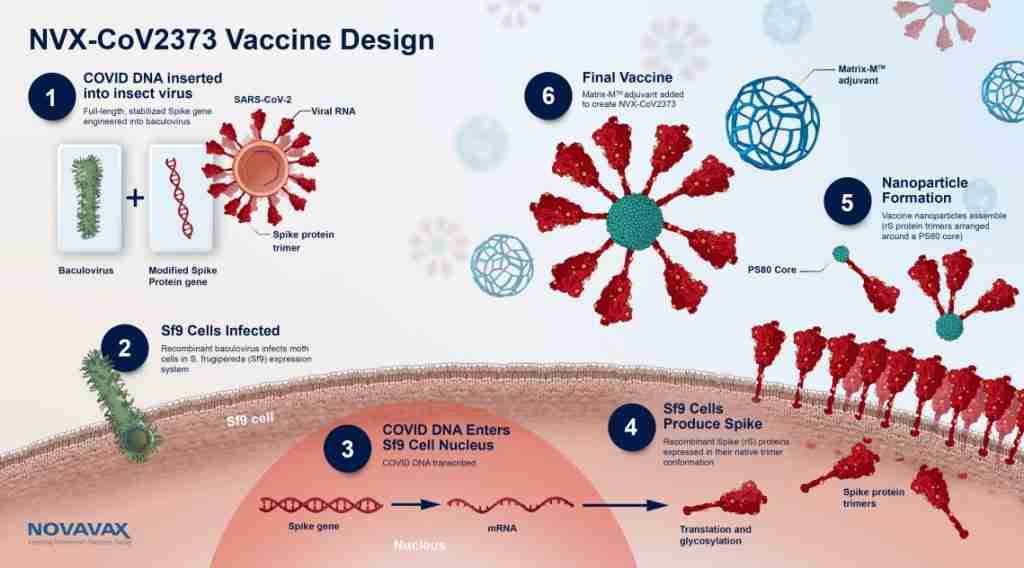
The Novavax method uses moth cells to make spike proteins:
- Researchers select the desired genes that create certain SARS-CoV-2 antigens (spike protein).
- Researchers put the genes into a baculovirus, an insect virus.
- The baculovirus infects moth cells and replicates inside them.
- These moth cells create lots of spike proteins.
- Researchers extract and purify the spike proteins.
Adjuvants increase the immune response to a vaccine. In this vaccine, soapbark tree extract adjuvant makes achieving immunity possible with a smaller dose of the spike protein.
Matrix-M is the adjuvant used by Novavax. It is based on a saponin extracted from the soapbark tree (Quillaja saponaria). The soapbark extract encourages immune cells to activate, generating a more potent immune response.
Saponins are found naturally in various plant species like beans and green peas. They’re used in agriculture, animal feeds, veterinary vaccines and human food. Saponins can boost immune responses to proteins. Using the Matrix-M adjuvant, a smaller dose of spike protein achieves the desired immune response.
A phase 2 trial in Australia and the USA expanded the age of participants to include 1,288 participants aged 18-84. Results of this study indicated that a two-dose regimen of 5-µg NVX-CoV2373 administered 21 days apart was the optimal vaccine dose to proceed to phase 3 trials.
Does 2 doses of the vaccine in a mandated 3 dose state (Victoria) mean that people who have Novavax can go to movies, cafes etc? I don’t know! I’m sure this will come out in the wash a bit later.
Preliminary phase 3 results indicate that side effects following administration of the Novavax COVID-19 vaccine have been generally mild to moderate, and short-lived. Injection site pain and tenderness, as well as fatigue, headache and muscle pain were the most commonly reported side effects.. The incidence of serious adverse events was low, and reported in similar numbers in both the vaccine arm and placebo group.
I am trying to get my head around Novavax, it’s efficacy, the side effects and future health implications. Based on the current political and health response to Covid the powers that be have proclaimed that the whole world must be vaccinated. That’s a whole subject win it’s own, one which I won’t go into here. Whether I need it or not to protect me against Covid is another story. The reason I need to get vaccinated is to get on a plane so I can travel.
All three of these vaccine classes – mRNA, viral vector and Novavax – are based around raising an immune response to a particular protein on the surface of the coronovirus – the so-called “spike” protein, which binds to receptors on the surface of target cells at the start of the process through which the virus makes its entrance. The mRNA vaccines and the viral vector vaccines both hijack the mechanisms of our own cells to get them to produce analogues of these spike proteins in situ. The Novavax vaccine is less subtle – the protein itself is used as the vaccine active ingredient. It’s synthesised in bioreactors by using a genetically engineered insect virus, which is used to infect a culture of cells from a moth caterpillar. The infected cells are harvested and the spike proteins collected and formulated. It’s this stage that, in the UK, will be carried out in the Teeside factory of the contract manufacturer Fujifilm Diosynth Biotechnologies.
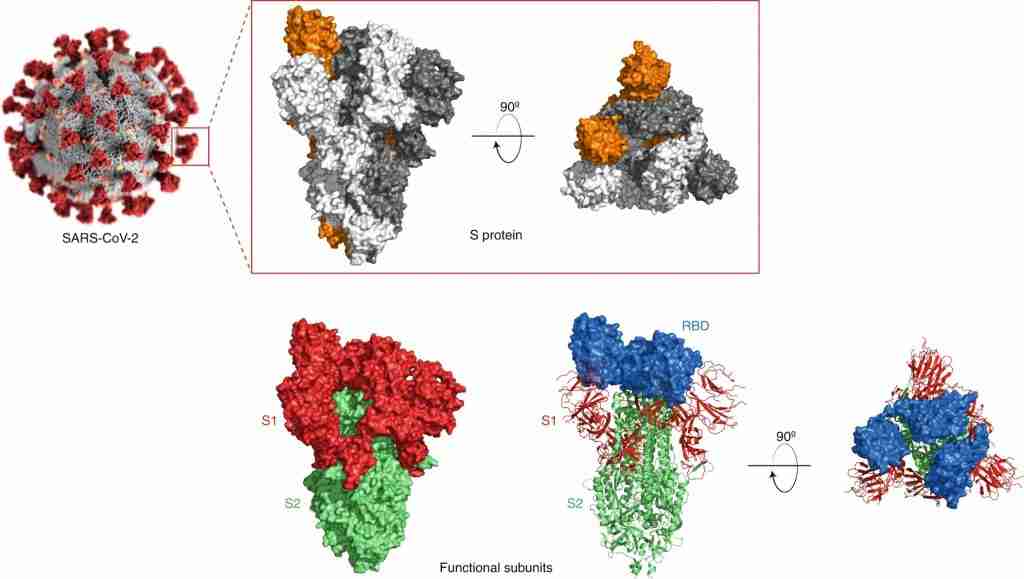
The protein used in the vaccine is a slightly tweaked version of the molecule in the coronavirus. The optimal alteration was found by Novavax’s team, led by scientist Nita Patel, who quickly tried out 20 different versions before hitting on the variety that is most stable and immunologically active. The protein has two complications compared to the simplest molecules studied by structural biologists – it’s a glycoprotein, which means that it has short polysaccharide chains attached at various points along the molecule, and it’s a membrane protein (this means that it’s structure has to be determined by cryo-transmission electron microscopy, rather than X-ray diffraction). It has a hydrophobic stalk, which sticks into the middle of the lipid membrane which coats the coronavirus, and an active part, the “spike”, attached to this, sticking out into the water around the virus. For the protein to work as a vaccine, it has to have exactly the same shape as the spike protein has when it’s on the surface of the virus. Moreover, that shape changes when the virus approaches the cell it is going to infect – so for best results the protein in the vaccine needs to look like the spike protein at the moment when it’s armed and ready to invade the cell.
This is where the nanoparticle comes in. The spike protein is formulated with a soap-like molecule called Polysorbate 80 (aka Tween 80). This consists of a hydrocarbon tail – essentially the tail group of oleic acid – attached to a sugar like molecule – sorbitan – to which are attached short chains of ethylene oxide. The whole thing is what’s known as a non-ionic surfactant. It’s like soap, in that it has a hydrophobic tail group and a hydrophilic head group. But unlike soap or comment synthetic detergents, the head group is, although water soluble, uncharged. The net result is that in water Polysorbates-80 self-assembles into nanoscale droplets – micelles – in which the hydrophobic tails are buried in the core and the hydrophilic head groups cover the surface, interacting with the surrounding water. The shape and size of the micelles is set by the length of the tail group and the area of the head group, so for these molecules the optimum shape is a sphere, probably a few tens of nanometers in diameter.
As far as the spike proteins are concerned, these somewhat squishy nanoparticles look a bit like the membrane of the virus, in that they have an oily core that the stalks can be buried in. When the protein, having been harvested from the insect cells and purified, is mixed up with a polysorbate-80 solution, they end up stuck into the sphere like a bunch of whole cloves stuck into a mandarin orange. Typically each nanoparticle will have about 14 spikes. It has to be said that, in contrast to the nanoparticles carrying the mRNA in the BioNTech and Moderna vaccines, neither the component materials nor the process for making the nanoparticles is particularly specialised. Polysorbate-80 is a very widely used, and very cheap, chemical, extensively used as an emulsifier in convenience food and an ingredient in cosmetics, as well as in many other pharmaceutical formulations, and the formation of the nanoparticles probably happens spontaneously on mixing (though I’m sure there are some proprietary twists and tricks to get it to work properly, there usually are).
But the recombinant protein nanoparticles aren’t the only nanoparticles of importance in the Novavax vaccine. It turns out that simply injecting a protein as an antigen doesn’t usually provoke a strong enough immune response to work as a good vaccine. In addition, one needs to use one of the slightly mysterious substances called “adjuvants” – chemicals that, through mechanisms that are probably still not completely understood, prime the body’s immune system and provoke it to make a stronger response. The Novavax vaccine uses as an adjuvant another nanoparticle – a complex of cholesterol and phospholipid (major components of our own cell membranes, widely available commercially) together with molecules called saponins, which are derived from the Chilean soap-bark tree.
Similar systems have been used in other vaccines, both for animal diseases (notably foot and mouth) and human. The Novavax adjuvant technology was developed by a Swedish company, Isconova AB, which was bought by Novavax in 2013, and consists of two separate fractions of Quillaja saponins, separately formulated into 40 nm nanoparticles and mixed together. The Chilean soap-bark tree is commercially cultivated – the raw extract is used, for example, in the making of the traditional US soft drink, root beer – but production will need to be stepped up (and possibly redirected from fizzy drinks to vaccines) if these vaccines turn out to be as successful as it now seems they might.
https://www.theatlantic.com/science/archive/2020/10/single-tree-species-may-hold-key-coronavirus-vaccine/616792/