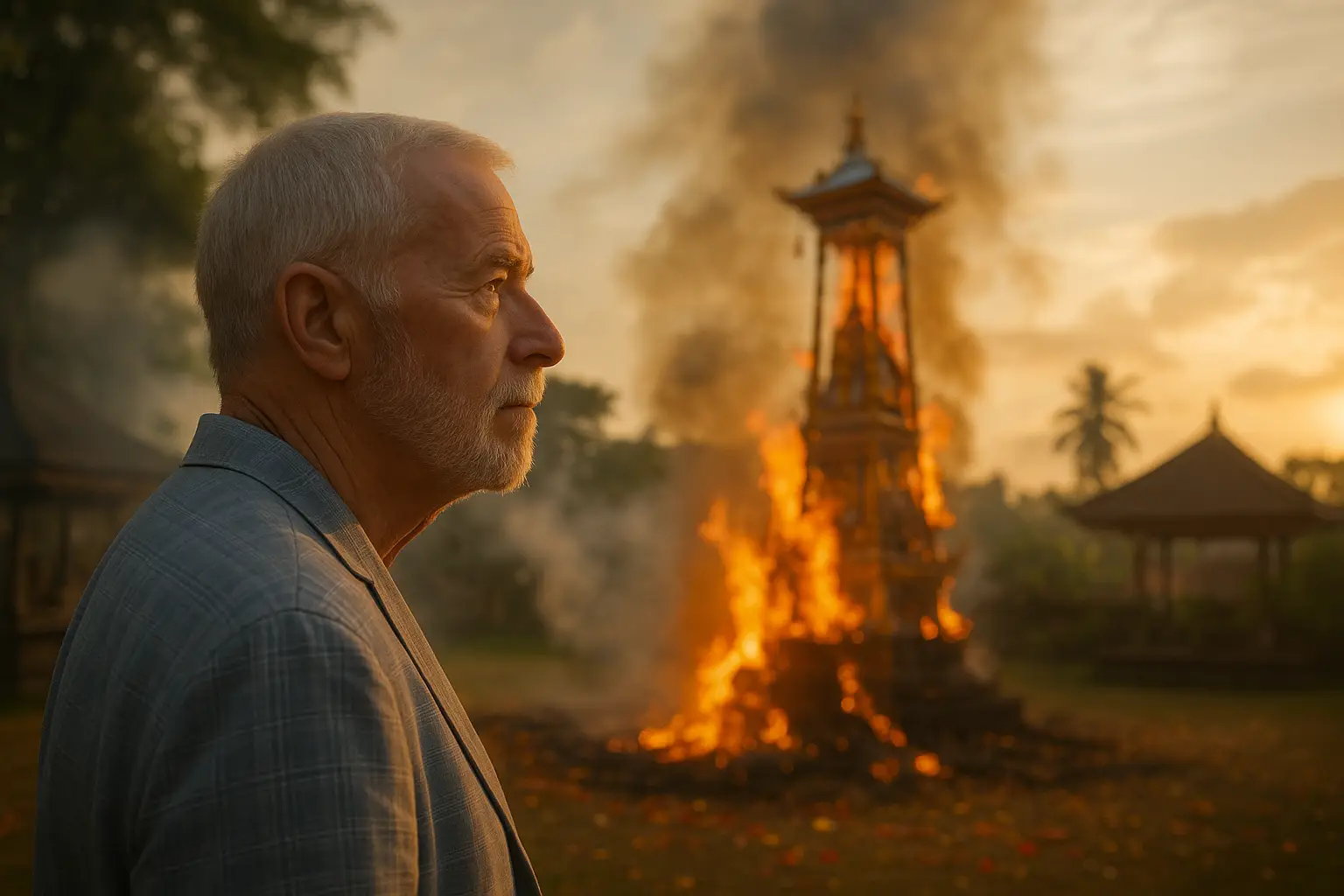
Funerals, Fire, and My Escape Plan from the Simulation
This morning we drove out to Springvale for Flora’s mum’s funeral. A Jewish cemetery, no fuss. Just family and friends gathered around a modest gravesite, the weight of shared history and generational change hanging in the air.
Even though I hadn’t seen her in years, she was woven into the fabric of my past—the 1970s and 80s especially. Flora’s mum was always around the edges, a quiet presence in the wings of our younger years. Today reminded me that nearly everyone from that era is gone now or heading that way. Georgie’s mum, Kaye, is the last one left in our immediate circle holding the torch for the older generation.
And that got me thinking—again—about death.
I’m Not Planning to Die Just Yet
Let me be clear: I’m not going anywhere any time soon. My current target is sometime after February 2052, which gives me nearly three more decades. That’s the plan, and I’m sticking to it. Fingers crossed, protocols followed.
But I’ve always been a planner. I like to know what I’m getting into—whether it’s a trip to Bali, a health reboot, or the next big chapter. So I’ve been giving death some thought—not morbidly, but practically, and maybe even philosophically.
The Fire in Bali and the False Comfort of the Western Funeral
I’ve long been drawn to the fire and ritual of Balinese cremations. There’s beauty in the flames, warmth in the music, and a kind of joyful reverence. They treat it like a transition, not just an ending.
Compare that to the cold sterility of Western funerals—polished coffins, dim rooms, small talk over egg sandwiches (not the case today though). It all feels a bit… performative. But in Bali, death breathes. It dances. It moves. And if I had to choose a way to go out—visually and energetically—that would be it. Fire over formality.
Simulation, Suffering, and the Recycling Station
Now here’s where my musings have taken a bit of a left turn in recent months.
I’ve been toying with the idea that this life—this reality—might not be what it seems. Maybe we’re not climbing the karma ladder, as I used to think. Maybe we’re not ascending to some spiritual ideal. Maybe, just maybe, this whole thing is a high-level simulation designed not for our enlightenment… but to extract something from us. Suffering. Negative emotion. Conflict. Drama. What if that’s the fuel? The energy source for some unseen architects who feed on the intensity of our experiences?
I know—it sounds outrageous. But no more outrageous than a burning bush, a pearly gate, or the idea that you’ll be reincarnated as a butterfly because you skipped the meat at lunch.
And if this simulation theory holds even a grain of truth, then death is not the release we think it is.
It might just be a reset.
A return to the “recycling station”—a term I’ve come to use for whatever processing centre awaits us after death. A place where the amnesia sets in, and before you know it, you’re back in a new body somewhere on Earth. No memory, no clarity. Just another round on the ride.
I Don’t Want to Come Back
That’s the real kicker. I don’t want to come back. If I’ve learned anything from this life, it’s that it’s rich with beauty and love, yes—but also that the system seems rigged for confusion and suffering. I don’t plan to linger in the familiar. I want to exit the cycle entirely.
The old Animals song keeps coming to mind:
“We’ve got to get out of this place, if it’s the last thing we ever do.”
And when the moment comes—when the light dims and the breath leaves—I want to be ready. Not ready to repeat, but ready to graduate.
What Funerals Remind Us
Funerals, at their core, aren’t for the dead. They’re for the living. And it’s the living—especially the family—who carry the sharpest pain. That grief, raw and visceral, is what tugs at your heart. It doesn’t matter how much time has passed since you saw someone. The finality of death, especially for the ones left behind, always lands hard.
As Flora said today with a hint of sad humour,
“Funerals are the only time I get to see all of the family and friends together.”
We gather in death to remember life. But for me, it’s also a reminder: this chapter will end. The curtain will fall. The only real question is—will I be ready to walk offstage and leave the theatre altogether?
I hope so.