Pre-Diabetes: A Wake-Up Call to Reclaim Your Health
There’s a version of me from about 8 or 9 years ago that still feels too close for comfort.
I was obese, sedentary, drinking daily, eating late at night, and loading up on carbohydrates like they were going out of fashion. Every afternoon was a fog. I’d crash hard—mentally and physically—and then push through it with coffee, sugar, or more food. I didn’t understand what was happening in my body. I didn’t even know what metabolism really meant.
In hindsight, the warning signs were blaring. I just didn’t know how to read them.
At some point I visited a local GP who told me I was pre-diabetic. The word pre made it sound manageable, even optional. There was no explanation of what pre-diabetes actually was. No mention of insulin, no advice beyond “cut out fatty foods” and a referral to a diabetes counsellor that I never followed up on.
She didn’t look particularly healthy herself, which probably didn’t help my motivation. But really, the truth is—I wasn’t ready to face any of it.
I didn’t understand that what was happening in my body wasn’t minor. It was a perfect storm—one that had been building for more than a decade. The daily drinking, the high-carb meals, the late-night snacking, the lack of movement, the crashes, the fog—it was all part of the same picture. And in that picture, cancer was slowly taking root.
When it finally showed up in 2020, I started piecing it all together.
What Pre-Diabetes Actually Means
Pre-diabetes is a state where your blood glucose levels are higher than normal but not yet high enough to qualify as type 2 diabetes.
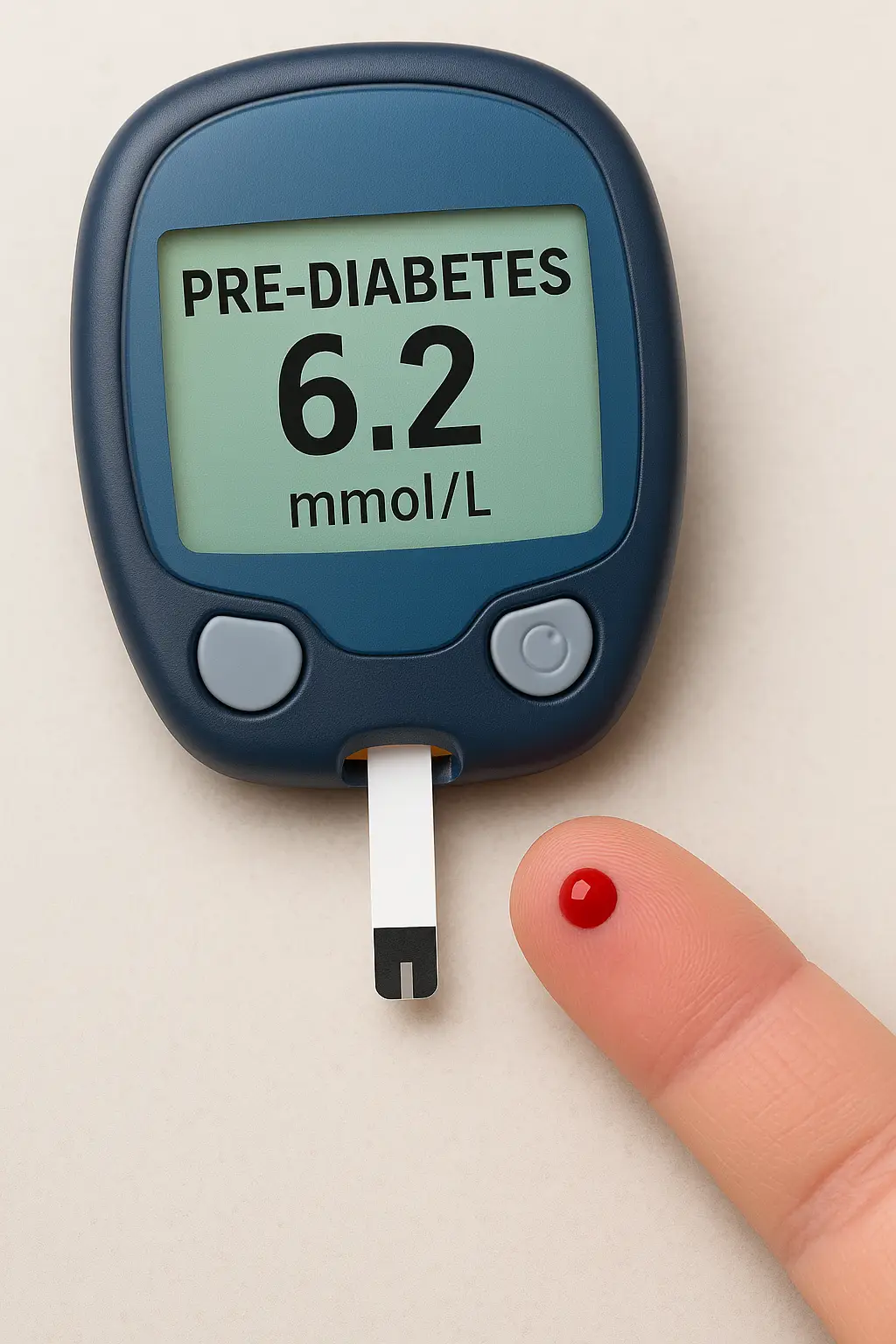
In Australia, it’s typically diagnosed with a fasting glucose between 5.6 and 6.9 mmol/L or an HbA1c between 5.7% and 6.4%. Most people don’t feel anything. They just slowly become more inflamed, more sluggish, more “off.”
By the time your glucose is rising, though, the damage has often been happening for years.
The root of it is usually insulin resistance—a condition where your cells stop responding properly to insulin, so your body has to pump out more and more of it just to keep your blood sugar in check. That elevated insulin—hyperinsulinemia—is often the first domino to fall, long before a doctor tells you you’re pre-diabetic.
Insulin resistance often leads to visceral fat, fatty liver, brain fog, and a whole cascade of other issues. And then, slowly, blood sugar follows.
The Bigger Picture
Looking back, I now know that pre-diabetes was just the early warning sign of something much larger. Metabolic dysfunction doesn’t just cause diabetes. It’s at the core of heart disease, Alzheimer’s, certain cancers, and even mood disorders.
I wish someone had told me that. I wish someone had sat me down and said: Mate, this is your chance. Change things now or you’re on a train that only speeds up from here.
But no one did. And I wasn’t ready to hear it anyway.
Processed Food, Alcohol, and Modern Life
It’s too easy to fall into it: the processed food, the bread, the pasta, the chips, the seed oils, the constant snacking. Add alcohol to the mix and you’ve got a metabolic time bomb.
I was living that life for years. I thought I was “getting away with it.” But there’s no free pass with metabolism. It keeps score.
And the score caught up with me.
Lifestyle First—Not Just Medication
Too many doctors are handing out Metformin when what people need is education, support, and real-life strategies. I’m not against medication when it’s necessary, but we’re not giving people the tools to help themselves.
When I finally understood what was going on, I didn’t just try to “cut back” on sugar. I changed everything.
I started tracking my glucose and ketones.
I moved to a low-carb, whole-food diet.
I started walking every day, lifting weights, doing saunas and cold plunges.
I gave my body space to breathe, to heal, to remember how it’s supposed to work.
And it did.
A Relapse—and a Reminder
Last year, after I broke my leg, I had to rest for nearly three months. My movement dropped, my strength fell off, and my blood sugar crept back up. It wasn’t a massive spike, but it was enough to remind me that pre-diabetes doesn’t just disappear. It waits.
And it comes back if you let it.
Luckily, I had the tools this time. I leaned back into what I knew: proper nutrition, fasting, hydration, training. My levels came down. The fog lifted. My body responded, just as it had before.
Don’t Wait
If your doctor says you’re pre-diabetic, don’t ignore it.
Don’t wait until your HbA1c hits 6.5%.
Don’t wait until you’re on daily meds or insulin.
Don’t wait until you’ve got neuropathy, or brain fog so thick you can’t think straight.
You have time. But not forever.
Learn what metabolism actually is.
Cut out the garbage food.
Move. Sleep. Breathe. Get some sun. Eat real food.
And if you’re reading this and it’s hitting a little too close to home, know this: you can turn it around. I did. You can too.
It starts with honesty. And one small step in the right direction.